The new journal was launched at a short ceremony at the UTAR Campus in Kampar this morning. It can be viewed at our website
http://uasj.utar.edu.my
To be kept informed by email of new issues, please 'subscribe' and enter you name, email and country.
I would like to have readers' reactions to help me develop this journal into something we will all find useful.
Monday, January 26, 2015

Tuesday, December 09, 2014
UTAR Agriculture Science Journal
Next month, January 2015, we will be launching a new journal called the UTAR Agriculture Science Journal. UTAR stands for Universiti Tunku Abdul Rahman, I am the editor of this journal and we have been working on it for a year.
Not another journal!! That is the incredulous response I have been getting. We are indeed flooded with journals, mostly dying ones. Every week I get invitations to contribute articles to this or that 'international journal of science' or join the editorial board or become a peer reviewer. I ignore all of them. Originally scientists published to spread information for the public good. Now publication is business. Publishers make profits by selling journals to libraries and to readers. Some make scientists pay a publication fee. Scientists try to get published in the journals that have the best international circulation. Such journals charge heavy subscription fees because they believe that good libraries have no choice but to pay up. The scientist is just a pawn in this business.
The UTAR Agriculture Science Journal will provide scientists with a global audience at no cost to them. We will make the journal totally free of charge on the Internet. Readers will be able to download the contents without restrictions.For libraries that need to have printed copies we will provide printed copies at absolutely no charge, not even for postage.
How long with this journal survive? Stay with this blog and we will find out.
Tuesday, November 04, 2014
Price tag on Tropical Fruits, Seeds, Seedlings and Trees
I checked with the Publication Unit in FRIM today on the pricing of the book Tropical Fruits, Seeds, Seedlings and Trees. The price at the FRIM bookshop is 250 Malaysian Ringgit. I mailed one copy to a friend in the USA today and that cost me RM 180 by postal air mail. The cost by Courier would have exceeded RM 300. The weight after packing was over 2 kg.
For overseas orders, the FRIM price is USD 150, not including postage.
As author I would like the book to be distributed quickly and cheaply but that is our of my hands.
For overseas orders, the FRIM price is USD 150, not including postage.
As author I would like the book to be distributed quickly and cheaply but that is our of my hands.
Tuesday, October 21, 2014
Tropical
Forest Fruits, Seeds, Seedlings and Trees
Author: F.S.P. Ng
Published in October 2014 by The Forest Research Institute
Malaysia (FRIM), Kepong, Selangor, Malaysia.

The biggest, most majestic, and least understood of all living things are the giant trees of high forests. It has been said that we know more about the big animals like elephants and whales than about the big trees.
The idea for this book began to take shape in the 1960s when
tropical forests were vast and challenging, and foresters considered it their
duty to restore logged forests by collecting and germinating seeds and tending
the seedlings until they grew into mature trees. This book was intended to be their
reference manual.
To ensure accuracy and consistency, all the relevant data
were obtained first-hand by personal observation and experiment. Other sources were
used to provide supplementary information. The book deals with over 600 species
of tropical forest trees, representing 309 genera and 86 families. It describes
the structure of their fruits and seeds, their germination characteristics, and
their subsequent development.
At maturity, the big trees are characterized by towering cylindrical
free-standing pillars rising 30 – 50 m or more above the ground, topped by spreading
leafy crowns. These pillars, which
foresters call clear boles, provide the logs of the timber industry. Clear
boles are ‘clear’ because all their branches have been shed and their scars smoothed
over so that no traces of branching remain.

Trees are built from ground up incrementally, according to genetically
predetermined programmes. These programmes were first recognized and described in
the early 1970s as tree architectural models. The recognition of these models
was the exciting highlight of dendrology—the science of trees—of the 1970s and
1980s.

With the recognition of post-architectural development, we
are closer to deciphering the complete development of trees.
Through the 1970s and 1980s, forest nurseries were
maintained in every forest district in Peninsular Malaysia to raise seedlings for
planting. This practice is now implemented strongly in Sabah but has lapsed in the
Peninsula, where forests are being left to regenerate themselves. Most forest nurseries
have closed and the ability of staff to recognize fruits, seeds, seedlings and
trees is rapidly being lost. Commercial nurseries have come into operation,
raising forest trees for establishment in urban areas, but the range of species
they grow is only a fraction of the diversity of tropical forests. The future
of many species now hangs in the balance, for without greater effort to
propagate and grow them to maturity, they will surely become extinct.
This book is sold at RM 250 at the bookshop in FRIM,
Kepong. Weighing 1.86kg, the book is 429 pages long and crammed with
germination data, line drawings of fruits and seeds, photographs of seedlings,
and illustrations of tree form and structure.
………………………….
The author joined the Forest
Research Institute Malaysia as Forest Botanist in 1964 and was its Deputy
Director-General in 1986 – 1990. He headed the Forest Research, Education and
Training Service of the Food and Agriculture Organization (FAO) of the United
Nations in Rome in 1991 – 1994. In 1994 – 1996 he was one of the founding
Directors of the Center for International Forestry Research (CIFOR) in Bogor.
Dr Ng was awarded the David Fairchild Medal for Plant Exploration in 2009 in
Miami. Among his other books are Tropical
Horticulture and Gardening (2006) and 100
Years of Tropical Forestry Research (2010). He is currently Consulting Editor to the Journal of Tropical Forest Science and
Editor of the UTAR Agriculture Science
Journal.
Tuesday, April 09, 2013
Is water damaged by boiling in a microwave oven?
Last week I received by email a post about the danger of using a microwave oven to boil water. It says that a schoolgirl in England did an experiment comparing water boiled in a microwave oven with water boiled normally.She used microwaved water on one potted plant and normal boiled water on another similar plant. She was shocked that the plant given microwaved water deteriorated daily and died in a few days while the other plant grew bigger and bigger. Photographs of the two plants were provided to show how the plants fared day by day.
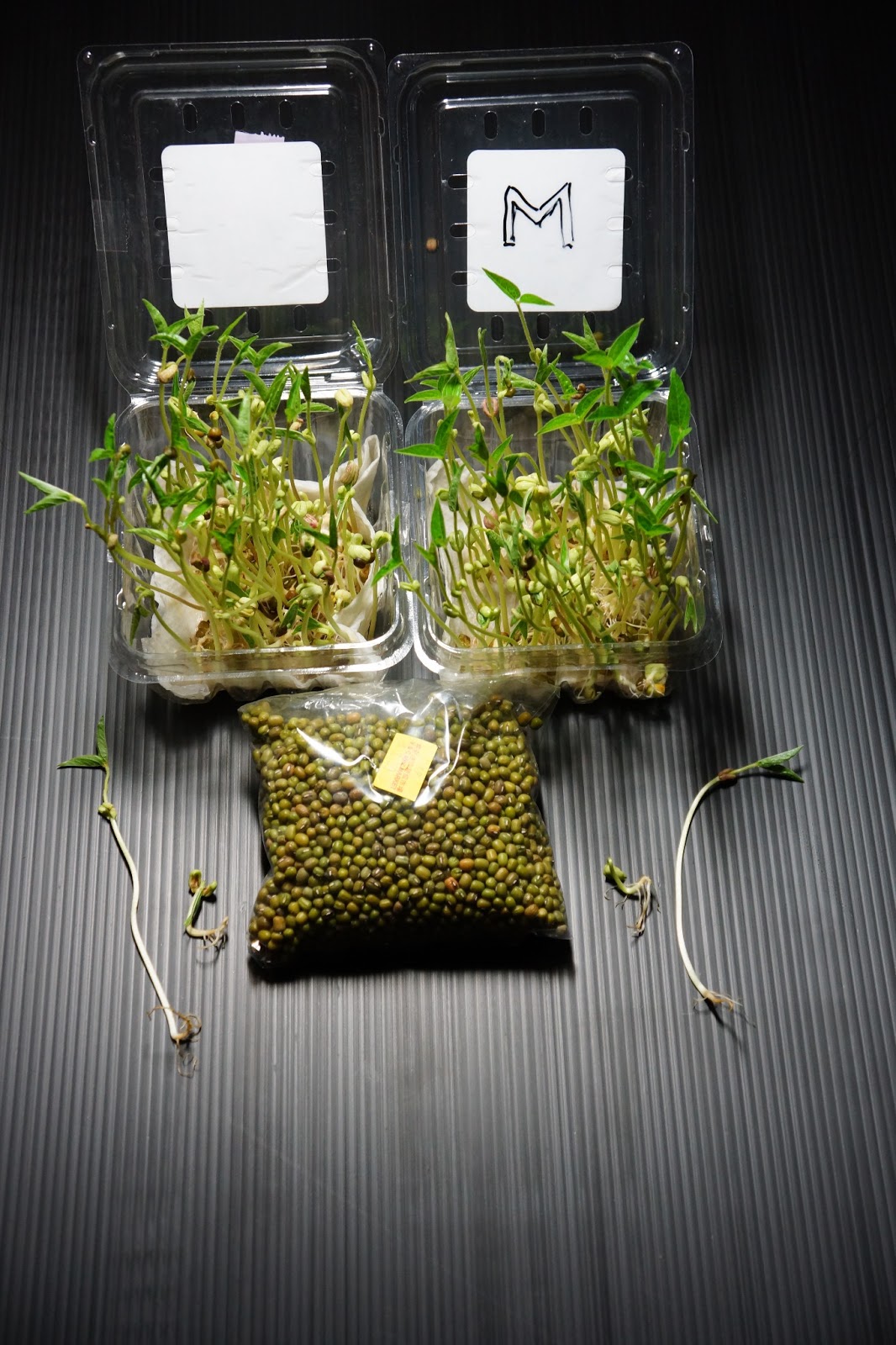
I decided to test this story by germinating bean sprouts. I bought a packet of seeds and placed seeds on tissue paper in ventilated transparent plastic boxes.Then I boiled one cup of water in a microwave oven and another in an electric kettle. After the water had cooled, I wetted one box with microwaved water and the other with kettle-boiled water. The seeds began to swell within an hour. Over the next four days the plants grew equally well in both boxes. Here are the pictures taken on the 4th day of my experiment.

The box on the right, with the letter M written on the lid is the one treated with microwaved water. There is no difference between the two sets of plants. In front of each box are two plants removed from each box to show the tallest and shortest plants in each box. Yes, there was variation within each box.
 The second picture shows the bag of seeds from which the experimental seeds were taken, to show that the seeds all come from the same source.
 The third picture shows all the seedlings taken out from each box and arranged by height. The label M indicates that the bottom row is the one treated with microwaved water. The range of variation is the same for both treatments.
 The fourth picture shows the seedlings grouped into small, medium and large size classes. The number of seedlings in each size class is indicated in the labels. I had 77 seeds in the box treated with microwaved water and 71 seeds in the other box.

The box on the right, with the letter M written on the lid is the one treated with microwaved water. There is no difference between the two sets of plants. In front of each box are two plants removed from each box to show the tallest and shortest plants in each box. Yes, there was variation within each box.


Anyone should be able to do this experiment, which illustrates a couple of important principles in scientific experimentation.
In an experiment comparing two treatments, all other factors except the experimental treatments must be the same. The boxes, the tissue paper, the room and table top, the source of seeds, even the observer, must all be the same. Only the water is allowed to be different. The experiment was carried out in a room that nobody else could enter and disturb.
The experimental materials i.e. the seeds and seedlings in this case, are naturally variable. There would be slow-growers, fast-growers and in-between growers. If we use a small number of seeds we may accidentally have a concentration of small growers in one box and fast growers in the other box and the experiment would fail to demonstrate the effect of the water.The number of seeds (we call it the sample size) must be large enough to override the natural variation. If we do not know what natural variation to expect, we should start with a big sample. In our case, 70 to 80 seeds turned out to be big enough. If we had started out with too small a sample we could not have obtained a clear-cut result.
Most experiments cannot be run so easily. The materials may be expensive and bulky e.g. coconuts instead of mung beans;subject to stringent ethical and moral controls e.g. humans and animals; require months or years to develop under unpredictable climatic and field conditions e.g. most field crops; impossible to obtains in large numbers from a uniform source. There are ways to deal with all these problems but the basic principles of experiment are the same.
Was the experiment by the English schoolgirl a deliberate fabricatiuon or a poorly planned experiment? I think it was a deliberate fabrication..
Monday, November 26, 2012
Kuala Lumpur rated fourth best shopping city after New York, Tokyo and London, ahead of Paris and Hong Kong
CNN came out with its list of the 10 best shopping cities in the world and to everybody's amazement, Kuala Lumpur came fourth immediately after New York, Tokyo and London. In fifth place was Paris and sixth was Hong Kong.
In Kuala Lumpur, 1 Utama was selected as the Shopping Mall of choice, and special mention was made of its "indoor rock-climbing facility, massive rooftop garden with 500 species of exotic plants, and indoor rainforest with koi ponds and freshwater aquarium".
You can read the report if you google for it under travel.cnn.com./worlds-10-best-shopping-cities. The report is followed by reader's reactions, mostly questioning why Kuala Lumpur of all places! Even Malaysians find it hard to believe.
I think 1 Utama stands out by offering attractions that other malls do not. In the rooftop garden I meet people who are delighted to be in a unique garden while their shopoholic spouses are shopping away inside the mall. Otherwise they would have had to hunt for a vacant seat (usually scarce) and struggle to avoid dozing off in a public place. Mall owners often do not realize that for every ardent shopper there may be a companion who is bored stiff. I also meet visitors from all over the world who have heard about this magical garden and have made it a point to visit when they come to Malaysia.
In the Rainforest in the Mall downstairs, smokers have a pleasant place in which to have a puff. I do not smoke myself but I know people who need to smoke once in a while.
Most mall owners think a dollar spent on a garden is a dollar down the drain and so most shopping malls end up like other shopping malls -- boring, over-commercialized and non user-friendly. It was good of CNN to make the point that the best shopping malls offer more than shopping.
Sunday, October 21, 2012
Oriental persimmon, Diopyros kaki, fruiting in Kuala Lumpur
The oriental persimmon, Diospyros kaki, is grown mainly in sub-tropical and temperate climates where the fruits ripen in late autumn and winter when the trees are bare of leaves. In the tropics the oriental persimmon is grown commercially on mountains at above 1000m, especially in Java and Sumatra. In Malaysia there have been attempts to grow persimmons in the Cameron Highlands but the industry has failed to take off commercially. The persimmon fruits in Malaysian supermarkets are all imported from overseas.
In the tropical lowlands, the oriental persimmon has been grown successfully in Kuching for at least three decades, in a few private gardens. I managed to obtain some seeds from Kuching and planted them in the rooftop Secret Garden of 1 Utama a few years ago. This week, the first batch of fruits began to ripen by turning yellow. The trees are fully leafed because the trees do not winter in KL. The fruits are undersized, measuring only 3.5 - 4 cm diameter, but this is a good start. .
In the tropical lowlands, the oriental persimmon has been grown successfully in Kuching for at least three decades, in a few private gardens. I managed to obtain some seeds from Kuching and planted them in the rooftop Secret Garden of 1 Utama a few years ago. This week, the first batch of fruits began to ripen by turning yellow. The trees are fully leafed because the trees do not winter in KL. The fruits are undersized, measuring only 3.5 - 4 cm diameter, but this is a good start. .
Subscribe to:
Posts (Atom)

